Narrow-Aisle Autonomous Forklift: Why Smart Factories Choose It First
When most companies discuss automation upgrades, their first instinct is often to invest in large systems or heavy equipment. That typically leads to long cycles, high investment, and slow returns. Factories that truly understand operational bottlenecks start with the most critical pain point: narrow aisles, low manual forklift efficiency, difficult turning, and inconsistent pallet alignment. These issues directly restrict logistics flow, and this is why narrow-aisle autonomous forklifts—especially compact AMRs like Reeman that can pass through 1.1-meter aisles—have become the fastest and most effective automation units to deploy.
Many facility managers underestimate how much “aisle width” affects efficiency. In narrow aisles, every reverse, micro-adjustment, and repositioning performed by a manual forklift adds up to significant time loss. The tight space also increases scraping and collision risks, creating high rack and pallet damage rates. A narrow-aisle autonomous forklift is not just small—it leverages AMR algorithms and high-precision sensing to complete turning, alignment, and pallet engagement within a 1.3-meter rotation radius. This level of consistent accuracy is nearly impossible for manual drivers and is unachievable for larger autonomous forklifts.
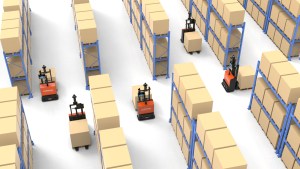
Reeman’s narrow-aisle autonomous forklift is specifically engineered for real Chinese manufacturing environments—dense layouts, irregular traffic lines, structural columns, complex lighting, and mixed pallet conditions. Traditional AGVs often “freeze” in narrow aisles due to fixed routes and limited obstacle-avoidance capabilities. AMRs, in contrast, excel in dynamic planning and real-time mapping, performing even better in complex environments. The combination of a compact chassis, laser LiDAR, 3D vision, and AMR navigation algorithms makes Reeman’s solution one of the most adaptable options for high-density facilities.
Load capacity is another area where most factory owners assume compact machines are weak. However, Reeman’s narrow-aisle autonomous forklift can reliably transport 1-ton loads and lift up to 1 meter, covering more than 70% of common pallet-handling scenarios. From inbound and outbound warehousing to line-side replenishment and semi-finished goods flow, it can take over most routine logistics tasks with standardized, repeatable, and system-integrated execution.
Another major advantage is its ability to increase space utilization without renovation. Narrow aisles are typically the bottleneck of logistics, but with a narrow-aisle autonomous forklift, the same footprint can accommodate more racks, higher density, and greater storage volume—turning limited warehouse space into productive capacity.
This is why factory owners who truly understand operations realize: automation is not about being bigger, but about solving the most real, frequent, and high-impact problems. Reeman’s narrow-aisle autonomous forklift is precisely that type of solution.
Article Source: Reeman


Comments
Post a Comment